
Buyers should require compressed, evenly strapped bales wrapped for moisture protection and stowed to tight-stow standards under the CTU Code. The single control to insist on is consistent machine-applied strap tension, using a named strap material, not manual tying. Before you pay, ask for bale weight, strap count and spacing, wrap type, and shipping documentation in writing.
TL;DR:
- Proper bales should be compressed to match density class, balancing freight costs and strap strength to prevent shape loss during transit.
- Consistent machine-applied strap tension and the use of PET or steel straps improve bale integrity and reduce failures caused by manual tension variation.
- Tight stowing with minimal voids, proper blocking, bracing, and clear photos before sealing are crucial to prevent bale shifting or collapsing during ocean transport.
- Packaging must include moisture protection, contamination barriers, and standardized documentation such as weight, strap count, and handling instructions.
- Suppliers should be ready to provide pre-shipment photos, packing specs, and evidence of compliance to avoid disputes and ensure secure, high-quality deliveries.
Table of Contents
- Common bale packaging methods and their tradeoffs
- Packing and securing bales for container transport
- Materials and equipment that determine bale integrity
- Compliance, safety, and documentation buyers should require
- How to specify packaging requirements and inspect shipments
- Sorting and preparing clothing before it gets packed
- How packaging choices affect clothing quality and resale value
- Sustainable packaging options for used clothing bales
- Handling fragile or delicate clothing items
- Packaging guidelines by shipment volume
- Packaging materials suited to used clothing bales
- A practical note on where bales actually fail
- How MS EXP SP Z O O applies these standards to every order
- Sources
- FAQ
Common bale packaging methods and their tradeoffs
Exporters compress used clothing into density classes before strapping. Higher density lowers freight cost per kilogram but raises outward force on straps, so density and strap strength have to be matched rather than chosen independently, according to industry bale-packaging guidance.
Strapping comes in a few forms. Pre-cut straps applied by machine give repeatable length and tension. Continuous coil systems feed strap automatically and cut to size, reducing waste on large runs. Material choice matters just as much as application method: PET, polypropylene (PP), and steel each behave differently under load and in transit conditions.
Outer protection varies by budget and destination climate. Inner poly bags keep clothing separated from strap abrasion, breathable sacks reduce condensation buildup in humid holds, and stretch film adds a moisture barrier around the compressed bale. Palletizing adds handling efficiency at both ends of the shipment and is worth insisting on for buyers running frequent container loads.
- Compression sets the density class, which affects both freight cost and strap load.
- Strap material and tension consistency determine whether a bale holds shape through transit.
- Wrap type protects against moisture and contamination during transit and storage.
- Palletizing improves forklift handling and reduces bale shifting inside the container.
Packing and securing bales for container transport
The IMO/ILO/UNECE CTU Code calls for a tight stow wherever possible, with cumulative horizontal voids inside a container kept to a minimum. Excess void space lets bales shift, lean, and eventually collapse under vibration and rolling motion during ocean transport.
- Confirm the packing plan targets a tight stow, with voids addressed by dunnage or bracing rather than left open.
- Check that blocking and bracing, or lashings such as top-over, half-loop, and spring lashings, are used where a full tight stow is not achievable, per CTU Code securing guidance.
- Ask whether bales are stacked in a cross-tie or interlocking pattern to spread load and keep the center of gravity controlled.
- Request photos showing dunnage placement, visible lashings, and no leaning or bulging bales before the container is sealed.
Pro Tip: Ask for a container interior photo taken from the door before closing. Leaning bales or visible gaps at that stage are the clearest sign of a rushed load.
Materials and equipment that determine bale integrity
Strap material choice affects both safety and shelf life of the bale. PET strapping tends to resist corrosion and recovers tension better than steel after minor stretch, which matters over long ocean transits. PP strapping is lighter and cheaper but stretches more under sustained load. Steel strapping holds the highest strength but rusts in humid holds and poses handling hazards if a strap snaps.
Automated tensioning machines and pre-cut strap systems apply consistent force across every strap on a bale, which reduces the risk of localized under-tensioning that leads to bulging or strap failure. Manual tying introduces variation strap to strap, and that variation is often the root cause of a bale that arrives loose or misshapen.
- PET straps: strong tension recovery, rust resistant, common on fiber-export bales.
- PP straps: lower cost, more stretch under sustained load, suited to lighter bales.
- Steel straps: highest strength, corrosion risk in humid transit, handling hazard if it fails.
- Dunnage and load-spreading boards: fill voids and distribute weight across pallet decks.
- Inner liners and sealed wraps: protect against moisture and contamination during transit.
Compliance, safety, and documentation buyers should require
Reference the CTU Code directly in purchase contracts rather than relying on general assurances. The code’s guidance on packing plans, payload limits, and pest prevention gives buyers a concrete standard to hold suppliers against, as outlined in the CTU Code quick guide.
Bale weight planning has commercial consequences beyond the shipment itself. Setting a conservative maximum weight that respects destination road limits and container payload limits avoids delays and disputes at the receiving end, even when it slightly raises per-bale shipping cost, per the ErgoPack bale-packaging guide.
Poor packing and securing of cargo transport units is a documented cause of serious transport incidents, according to IMO guidance on cargo securing, which is why codes like the CTU Code exist as a joint standard for the shipping industry.
- Require contents, net weight, handling notes, and PO reference on every bale label.
- Require pre-sealing photos showing straps, wrap, and stacking pattern.
- Require evidence of pest control and clean wrap free of visible contamination.
- Require a packing plan that states payload limits were checked against the container and route.
How to specify packaging requirements and inspect shipments
Put the spec in the purchase order, not in a side conversation. A workable spec states target bale density, maximum bale weight, strap material and spacing, wrap type, whether bales are palletized, and what labeling fields are required. Ask for photos before the container is sealed as a condition of payment release.
- Write the bale spec into the PO: density target, max weight, strap material and count, wrap type, palletization, and labeling fields.
- At dispatch, check strap tension visually (no slack, no bulging seams) and confirm bale geometry and pallet stability.
- At arrival, compare the shipment against the spec: weight, strap count, wrap condition, and label accuracy.
- On any mismatch, require rework or hold release until the supplier provides corrective photo evidence.
Pro Tip: Keep the same spec sheet across every supplier you buy from. It turns a subjective quality complaint into a documented breach you can act on.
Sorting and preparing clothing before it gets packed
Sorting happens before a single strap is applied, and it shapes everything downstream. Clothing gets separated by grade, garment type, and sometimes season, since mixing summer and winter stock in one bale can misrepresent the lot’s resale value. Rags and unsellable items are pulled out at this stage rather than discovered by the buyer after the bale is opened.
Preparation also includes a basic contamination check. Wet or mildewed garments removed before compression protect the rest of the bale from moisture damage during transit. Buyers should ask whether sorting happens before or after compression, because sorting after the fact usually means the bale was packed first and graded later, a sequence that raises the odds of mixed-grade lots.
A consistent sorting process also supports accurate labeling. When contents are graded and counted before packing, the label on the bale can state contents and grade with confidence rather than as an estimate. That accuracy matters more to a wholesale buyer reselling by grade than almost any other single detail in the transaction.
How packaging choices affect clothing quality and resale value
Packaging is not just a shipping formality, it changes the condition of the garments inside. Overcompression can crease or crush delicate fabrics permanently, while undercompression wastes container space and raises the buyer’s landed cost per garment. The density target has to match what the garment type inside the bale can tolerate.
Moisture is the other major factor. A wrap that fails to protect against condensation during a long ocean transit can leave an entire bale with mildew, turning resalable stock into loss. Strap damage tells a similar story: straps applied too tight or without spacing can cut into garments near the surface of the bale, leaving visible marks that lower resale grade.
Buyers who inspect bales on arrival often find that packaging quality correlates directly with grading accuracy. A well-packed, well-labeled bale from a careful sorting process tends to match its stated grade far more closely than a rushed one, which affects how confidently a reseller can price the lot before even opening it.
Sustainable packaging options for used clothing bales
Sustainability in bale packaging mostly comes down to material choice and reuse. PET strapping, in addition to its tension performance, is more readily recyclable than mixed-composite alternatives, and some exporters offer reusable pallet programs that cut down on single-use wood waste across repeat shipments.
Wrap materials matter too. Buyers can ask whether stretch film is a minimal-thickness recyclable grade rather than a heavier film chosen only for handling convenience. Reducing wrap thickness where it still protects against moisture cuts plastic use without compromising the bale’s integrity in transit.
None of this should come at the cost of protection. A thinner wrap that fails to guard against condensation creates more waste in the long run, since the damaged garments inside are unsellable and the packaging itself still has to be disposed of. The practical goal for a buyer is to ask suppliers what recyclable or reusable materials they use for straps, wrap, and pallets, and to weigh that against whether the bale still arrives dry and intact.
Handling fragile or delicate clothing items
Not every bale holds the same kind of garment, and delicate items such as lace, silk, or beaded pieces need different handling than heavy denim or workwear. Mixing fragile garments into a standard high-density bale risks crushing or tearing them under the same compression that a denim bale tolerates without issue.
Buyers sourcing higher-grade or vintage stock should ask suppliers whether fragile items are segregated into lower-density bales or boxed separately rather than compressed at the same ratio as bulk clothing. A lighter compression setting, combined with extra inner padding or a dedicated liner, protects garment structure that a standard bale wrap would not.
Labeling matters here as much as packing method. A bale or box containing delicate or vintage items should carry a handling note distinct from a standard bulk clothing label, so that forklift operators and warehouse staff at both ends of the shipment know to handle it differently. Skipping this step is a common reason vintage or delicate lots arrive with damage that a standard bale would never show.
Packaging guidelines by shipment volume
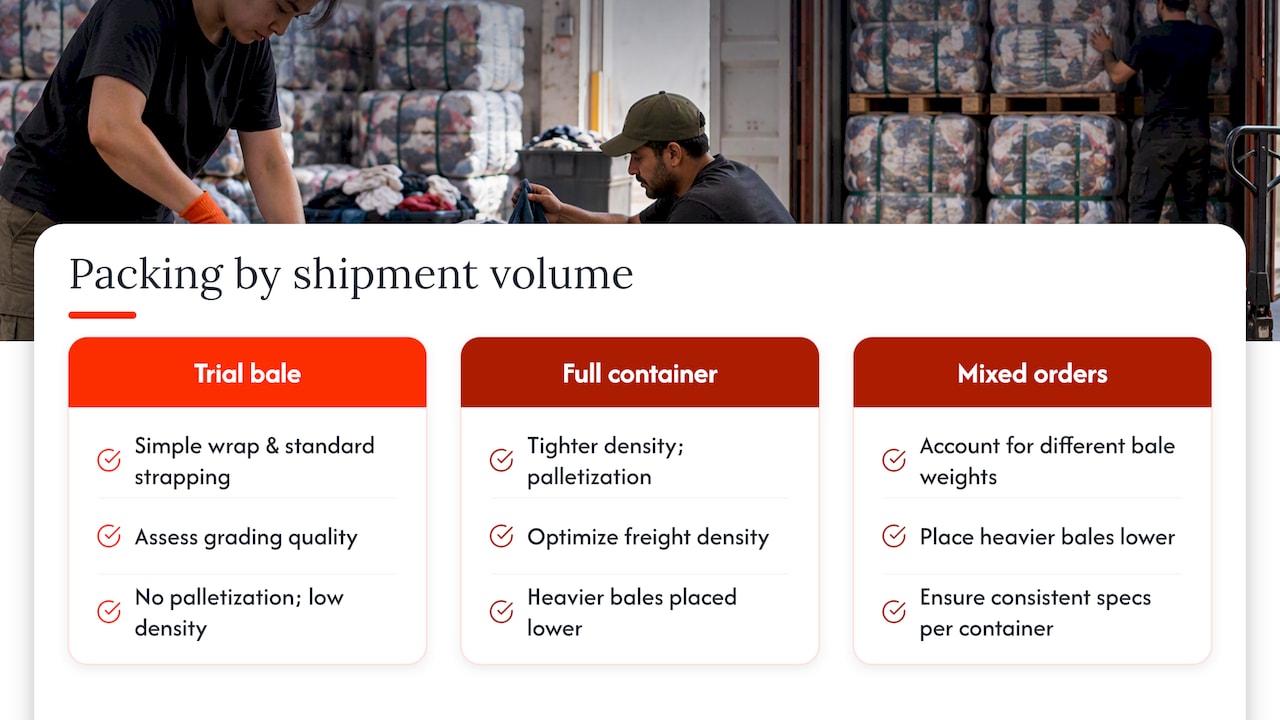
A single test bale calls for a different packing approach than a full container load. Small trial orders benefit from simpler wrap and standard strapping since the buyer’s goal is usually to assess grading quality, not to optimize freight density. Full container loads justify tighter density targets and palletization, since the extra handling investment pays off across the larger volume.
Mixed-volume orders, where a buyer takes several product categories in one shipment such as clothing alongside used shoes, need a packing plan that accounts for different bale weights and shapes sharing the same container. Heavier, denser bales generally belong lower in the stack, with lighter or more compressible bales above, to avoid uneven lateral pressure on the container walls.
Buyers ordering at scale should also ask how a supplier sequences multiple containers in one order. Consistent bale specs across every container in a multi-unit order matter more than buyers often expect, since a single container packed to a different standard can throw off an entire receiving inspection and delay release of the full order.
Packaging materials suited to used clothing bales
The core materials are straightforward: inner poly bags or liners, strapping in PET, PP, or steel, outer stretch film or breathable sacks, and pallets for palletized loads. Each plays a distinct role, and skipping one for cost reasons usually shows up as a problem later in transit.
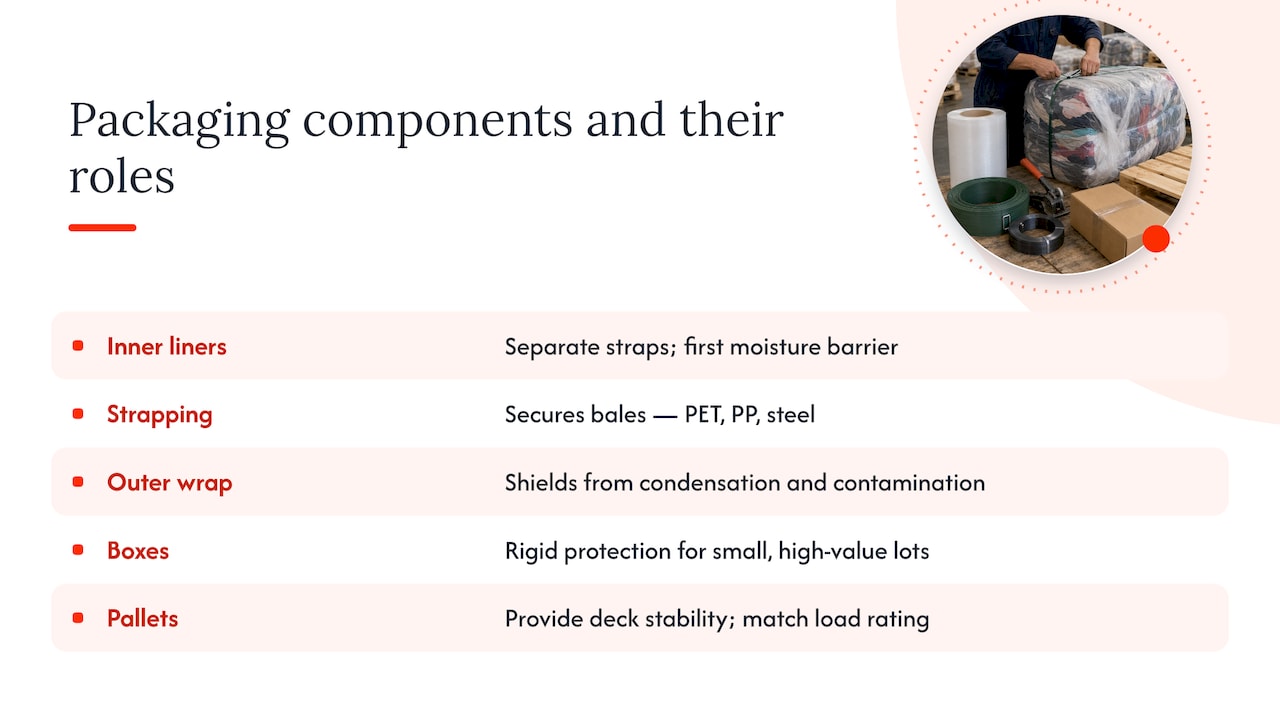
Inner liners separate clothing from direct strap contact and add a first layer of moisture protection. Outer wrap, whether stretch film or a breathable sack, is the main defense against condensation and contamination during the shipment. Boxes see more use for smaller, higher-value lots such as used purses and bags, where rigid protection matters more than compression efficiency.
Pallets deserve their own scrutiny. A pallet built to a consistent deck size and load rating, paired with load-spreading boards, keeps bales stable through multiple handling points. Buyers working with heavier textile lots, like industrial wiping rags, should confirm pallet specs match the bale weight class, since an undersized pallet under a heavy load is a common cause of in-transit collapse.
A practical note on where bales actually fail
Most failed bales trace back to one cause: inconsistent strap tension from manual application. Automated tensioning removes that variable. Attach your spec checklist to every purchase order rather than trusting a verbal agreement.
— rodrigues
How MS EXP SP Z O O applies these standards to every order
The supplier uses machinery built for consistent bale packaging, supporting faster turnaround on bulk orders of used clothing, shoes, and related goods. The warehouse offers ample space to supply large or mixed-category orders without delay, and the business ships to buyers in multiple countries.
Buyers who want to confirm packing standards before committing to a full order can request a sample bale spec and pre-shipment photos directly.
- Ask for a sample bale spec covering density, strap material, and wrap type before placing a bulk order.
- Request packing photos and a pre-shipment checklist confirmation ahead of container sealing.
- Start with the used clothing product page to see current bulk lot options and request a quote.
FAQ
What is the CTU Code and why does it matter for bale shipments?
The CTU Code is a joint IMO, ILO, and UNECE code of practice for packing cargo transport units, covering tight stow, void management, and securing methods like blocking, bracing, and lashings. Buyers can reference it directly in contracts to set a concrete standard for how bales should be packed and secured, as detailed in the CTU Code.
Which strap material is best for export bales?
PET strapping is often favored for used clothing bales because it resists corrosion and recovers tension better than steel after minor stretch during long transits, according to industry bale-packaging guidance. PP strapping costs less but stretches more under sustained load, while steel offers the highest strength but carries corrosion and handling risks.
How do I check if a bale was packed correctly before shipping?
Look for even strap tension with no slack or bulging seams, stable bale geometry, and photos of the container interior showing minimal voids and visible lashings before sealing, per CTU Code securing guidance. Requiring these photos as a condition of payment release gives buyers a documented check rather than a verbal assurance.
Does MS EXP SP Z O O provide packing confirmation before shipment?
The supplier uses machinery for bale packaging and can provide packing details as part of the order process for bulk buyers. Buyers can request a sample bale spec and pre-shipment photos directly through the used clothing page.
What should I do if a bale arrives outside the agreed spec?
Compare the shipment against the written spec for weight, strap count, wrap condition, and labeling, and document any mismatch with photos. Request rework or hold payment release until the supplier provides corrective evidence, a practice supported by CTU Code packing-plan recommendations.