
Most wholesalers order full 20ft or 40ft/40HC containers, choosing size based on expected bale weight and destination handling capacity. The single step that prevents the most rejections is securing verified gross mass (VGM) documentation and sanitation certificates before the vessel stowage deadline. Before anything else, confirm your seller’s bale specs: weight, dimensions, grade mix, and packing photos.
TL;DR:
- Securing verified gross mass documentation and sanitation certificates before vessel stowage is crucial to prevent shipment rejections.
- Using 15 to 25 kg bales increases unit count per container but extends handling time compared to heavier, more compressed bales.
- Proper bale grading, consistent labeling, and compression on hydraulic or mechanical balers minimize rejection risks and optimize container fill.
- Responsible pre-shipment procedures include confirming bale details, obtaining VGM and certificates, and verifying logistics documentation.
- Clear contract specifications, including photo evidence and weight certificates, help avoid disputes related to bale quality and re-weighing responsibilities.
Table of Contents
- Container types, capacities, and expected bale yields
- Preparing, sorting, and compressing bales to maximize yield and avoid rejections
- Container loading and stacking best practices for safety and space efficiency
- VGM (SOLAS), fumigation/sanitation, and essential shipping documents
- How to evaluate quotes: price components, MOQ, lead time, and Incoterms advice
- A concise pre-shipment checklist sellers and buyers should follow
- MS EXP SP Z O O: verifiable publisher proof points and how they support container orders
- Negotiation and specification perspective to avoid common disputes
- How to request a container quote from MS EXP SP Z O O
- FAQ
- Sources
Container types, capacities, and expected bale yields
Container choice depends on gross mass limits and how your bale weights fill available cubic space. A standard 20ft container typically handles loads up to a range of mass limits depending on carrier and chassis limits, while a 40ft or 40HC container offers roughly double the cubic volume with a similar or slightly higher mass ceiling, since weight rather than volume usually caps a used clothing load.
Field research on second-hand clothing shipments found containers arriving with typical gross weights and individual bale weights varying depending on sorting grade and compression method, according to UNECE field observations. Using these figures, a container filled with 25 kg bales yields more units than when filled with heavier bales, affecting bale counts per container.
- Lighter bales (15 to 25 kg) pack more units per container but take longer to count and verify at origin.
- Heavier compressed bales (35 to 45 kg) reduce handling time per kilogram but need stronger strapping to hold shape.
- Mixed-grade loads or loose-packed items (shoes, bags, toys) reduce cubic efficiency and should be quoted separately from pure clothing bales.
Preparing, sorting, and compressing bales to maximize yield and avoid rejections
Consistent bale quality starts with a clear grading specification in the purchase order, not a vague request for “good quality” stock. Buyers should spell out what first, second, and third quality mean for their market before the first bale is pressed.
- Define grade categories in writing, specifying the percentage mix of first, second, and third quality items the seller must deliver.
- Set bale dimensions and target weight range appropriate for the shipping lane and handling equipment at destination.
- Require strapping with polypropylene bands and either woven poly or burlap wrapping that survives ocean transit without tearing.
- Specify that bales be compressed on hydraulic or mechanical balers, since denser bales reduce the number of units needed to fill a container and cut handling time.
- Insist on checks for off-odors, moisture content, and visible contamination before bales leave the sorting facility.
- Require legible labels on every bale showing grade, approximate weight, and a batch or lot number tied to the packing list.
Uniform bale dimensions and consistent labeling speed terminal handling at destination and lower the chance of a customs hold triggered by inconsistent paperwork, a pattern UNECE’s trade research ties directly to reduced local repacking costs.
Pro Tip: Ask for time-stamped photos of bales on the warehouse floor before loading, not just finished-product shots from a catalog.
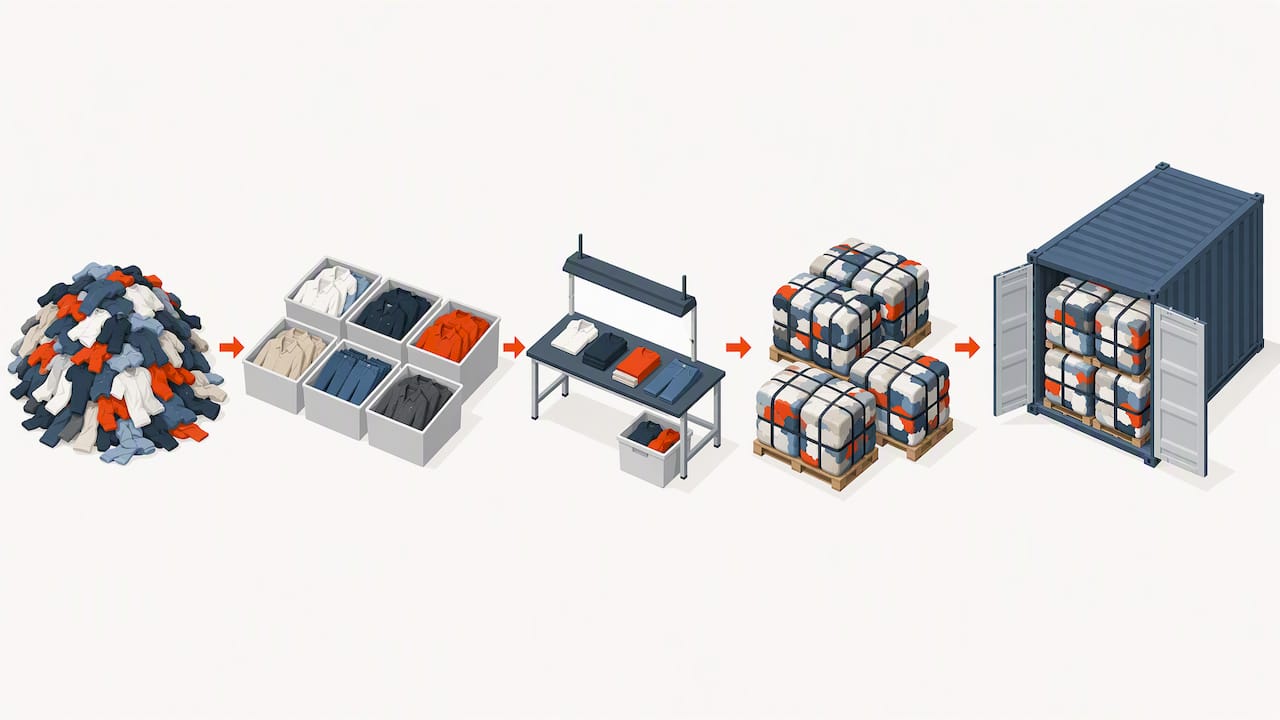
Container loading and stacking best practices for safety and space efficiency
Loading sequence affects both safety and how much product fits. Heavier bales generally go in first and low, with weight distributed evenly fore to aft and side to side so the container does not list during transit or crane lifts.
- Build stacks from the floor up, keeping heavier or denser bales on the bottom tiers and lighter bales or loose items on top.
- Limit stack height based on bale compression; loosely packed bales shift and settle more than hydraulically compressed ones, so they need lower maximum stacks.
- Use dunnage boards or airbags at the door end to stop bales from shifting against the doors during rough seas.
- Strap or block the final tier so nothing leans against the container doors when they open at destination.
Palletizing bales speeds loading and unloading with a forklift but sacrifices cubic space since pallets themselves take up volume, a tradeoff worth discussing with your freight forwarder before booking. Floor-loaded bales maximize yield per container but take longer to load and unload by hand.
Pro Tip: Share your stacking plan with the terminal handler in advance so they know which end holds the heaviest weight before the container is set on the chassis.
VGM (SOLAS), fumigation/sanitation, and essential shipping documents
Since July 2016, SOLAS regulation VI/2 has required every shipper to provide a verified gross mass before a packed container can be loaded aboard a vessel, under guidance detailed in MSC.1/Circ.1475. Shippers can meet this requirement either by weighing the packed container as a whole or by weighing each package and adding the container’s tare weight, and the VGM must reach the carrier before the vessel’s stowage planning deadline, which is typically a few days ahead of departure depending on the port.
Misdeclared mass can disrupt a vessel’s stowage plan, and the same IMO guidance notes that a vessel’s master retains the discretion to refuse a container that lacks a valid VGM, with some terminals able to weigh containers on a shipper’s behalf when arrangements allow it.
- Confirm who is responsible for obtaining the VGM and how the cost is allocated before booking.
- Build in time for fumigation or disinfection certificates where the destination country requires them for used textiles.
- Prepare a full documentation set: packing list, bill of lading, commercial invoice, and fumigation or phytosanitary certificates when applicable.
Sanitary requirements for used clothing vary significantly by destination, so confirming current rules with the importing country’s customs authority before shipment is worth the time it takes. UNECE and ECLAC guidance also recommends digital traceability records tied to bale IDs, which helps distinguish genuine reuse shipments from textile waste during customs review.
How to evaluate quotes: price components, MOQ, lead time, and Incoterms advice
A container quote bundles several cost layers, and understanding each one lets you compare offers on equal terms rather than on a single bottom-line number.
- Goods cost: the per-kilogram or per-bale price for the grade mix ordered.
- Packing and baling labor, including compression and strapping materials.
- Inland haulage from the warehouse to the port of loading.
- Fumigation or sanitation treatment where the destination requires it.
- Terminal handling charges, ocean freight, and destination port charges.
- Inland delivery at destination if the buyer wants door delivery rather than port pickup.
Minimum order quantities commonly run a full container, though some sellers accommodate half-container or pallet-level minimums for buyers testing a new market.
Incoterms guidance from the ICC’s Incoterms 2020 rules favors FCA for container shipments, since the seller hands the container to the carrier at a terminal and both parties get clarity on who arranges VGM and documentation from that point forward. FOB and CPT remain common too, but each shifts responsibility for the VGM step and inland costs differently, so confirm this in writing before signing. Lead time from order confirmation to vessel departure typically spans several weeks once packing and documentation windows are factored in.
A concise pre-shipment checklist sellers and buyers should follow
- Confirm bale counts, weights, and photos match the commercial invoice and packing list before loading begins.
- Obtain the verified gross mass in time for the carrier’s stowage plan and confirm in writing who arranges and pays for weighing.
- Secure fumigation or sanitation certificates where the destination requires them, and double-check current rules with local customs.
- Verify the container sealing procedure, confirm bill of lading details match the shipment, and check customs entry prerequisites are in place.
MS EXP SP Z O O: verifiable publisher proof points and how they support container orders
We operate using baling machinery that lets us turn orders around quickly without sacrificing bale consistency. Our product range spans various categories which lets buyers consolidate mixed-category orders into a single container when that suits their market.
- We maintain a warehouse that supports consistent supply across grade mixes and product categories.
- Partners describe our relationship as reliable and our product quality as consistent.
- Our packaging machinery produces uniform bale dimensions that can speed terminal handling at destination.
Negotiation and specification perspective to avoid common disputes
Most container disputes trace back to specifications that sounded clear at the time of ordering but left room for disagreement later. A grade definition without an acceptance test is an invitation to argue after the container has already sailed. Contracts should name photo evidence and weight certificates as conditions of acceptance before loading, not as a courtesy. They should also fix who pays for a re-weighing if the destination terminal’s figure disagrees with the origin VGM, since that gap causes more friction than almost any other line item in a shipment.
— rodrigues
How to request a container quote from MS EXP SP Z O O
We quote fastest when a buyer sends us the essentials up front, so share what you can before the first call.
- Container size preferred (20ft, 40ft, or 40HC).
- Grade mix and any specific categories to include, such as used shoes or recycled industrial wiping rags.
- Destination port and preferred Incoterms.
- Target vessel departure date.
Visit our used clothing page to start a quote request with these details ready.
FAQ
What is the 3-3-3 rule for clothes?
The 3-3-3 rule is a personal wardrobe decluttering method, not a wholesale grading standard, where someone wears a small rotating set of pieces for three months to identify what they actually use. It has no bearing on commercial bale grading, where grades are defined by condition and fabric type rather than personal usage habits.
Where can I find second-hand clothing bales?
Secondhand clothing bales are sourced from wholesale exporters who sort, grade, and compress donated or collected garments into standardized units for container shipment. Buyers typically request grade specifications, bale weight, and packing photos directly from an exporter before placing a container order.
What to do with old clothes which cannot be donated?
Garments too worn or damaged for resale or donation are typically diverted into textile recycling streams, such as industrial wiping rag production or fiber reclamation, rather than discarded as household waste. Many exporters that handle used clothing also process this category separately as recycled industrial wiping rags.
Who pays the highest for used clothes?
Prices for used clothing vary by grade, destination market, and volume, so there is no single buyer type that consistently pays the most across all markets. Wholesale exporters typically price bales by grade mix and weight, and buyers get the most accurate figure by requesting a quote based on their specific order.
Sources
- Verification of the gross mass of a packed container
- Trade in second-hand clothing: field observations and policy options (UNECE)
- Incoterms® 2020 – rules and commentary (ICC Digital Library)