
Yes, you can export used footwear for resale, but only when the supplier provides graded, export-ready bales, clear HS classification and proper export paperwork. That means grade codes, consistent bale weights, an HS code declaration under heading 6309 where it applies, packing lists and pre-shipment evidence. Skip any of those and a shipment risks delays, duty disputes or outright rejection at customs.
TL;DR:
- Exported used footwear must be graded, documented with accurate HS classification, and accompanied by packing lists, invoices, and evidence of sorting for reuse.
- Quality grading determines resale value, with Grade A suitable for premium shops, Grade B for markets, and Grade C for recycling or industrial use.
- Bale sizes, weights, and packing methods influence freight costs and customs inspections, with compressed ocean freight bales being most common.
- Customs classification under HS heading 6309 depends on proof of wear and proper bulk presentation, avoiding reclassification risks and duty disputes.
- Securing a verified warehouse with proper sorting and documentation reduces risks, while detailed pre-shipment samples and clear paperwork streamline customs clearance.
Table of Contents
- How grading determines quality and resale value
- What to expect from bale formats, weights and lead times
- Getting HS classification and compliance right
- Building a QA checklist for export-ready bales
- What drives pricing, MOQs and payment terms
- Where to source stock and which markets want which grades
- Why a verified warehouse exporter reduces buyer risk
- How to request a quote and start your order
- An exporter’s honest take on what actually works
- FAQ
- Sources
How grading determines quality and resale value
Commercial grading is the backbone of a working used footwear deal. Grade A typically means lightly worn pairs with matching sizes, minimal scuffing and no structural damage. Grade B allows more visible wear, scuffs or minor sole separation but still sells as intact pairs. Grade C, and what some suppliers label Grade 4, covers heavily worn stock, singles or items destined for recycling and wiping rather than retail resale. The grade a buyer orders should map directly to the resale channel.
- Grade A suits boutique resellers and premium secondhand shops that pay the highest per-kg rates.
- Grade B works well for market stalls and general wholesale resale in price-sensitive regions.
- Grade C or mixed-condition stock fits scrap, recycling or industrial reuse rather than retail shelves.
Matching pairs, consistent sizing within a bale and brand sorting all affect how fast the stock turns over once it lands.
What to expect from bale formats, weights and lead times
Bale weight and packing method shape both freight cost and how easily customs can inspect a shipment. Common bale weights in the secondhand footwear trade run in set ranges depending on the supplier’s compression equipment, and denser bales reduce shipping cost per kilogram but can make visual inspection harder at the port.
- Standard bales are compressed and strapped for ocean freight, which keeps volume down and protects contents from moisture.
- Loose or loosely packed options exist for buyers who want easier pre-sale sorting, though they cost more to ship per kilogram.
- Palletized or container-ready formats speed up loading and reduce handling damage during transit.
Dispatch windows vary by order size and destination port, and buyers should build in extra time around holidays, peak shipping seasons or when a supplier is running a large production batch. Confirming a realistic dispatch date before paying a deposit avoids most of the scheduling disputes that surface later in the order cycle.
Getting HS classification and compliance right
Used footwear shipped in bulk generally falls under HS heading 6309, the code covering worn clothing and other worn articles, including footwear, presented in bulk rather than retail packaging. National subheadings add further granularity, so the exact code can shift depending on the importing country’s tariff schedule.
Some mixed consignments can face reclassification risk when items lack documented wear or sorting, according to customs ruling guidance on used clothing. That ruling explains that items must show appreciable wear and arrive in bulk to qualify under 6309. Commingled loads containing items that do not meet that standard risk being reclassified into a higher-duty chapter or flagged as waste rather than reusable goods.
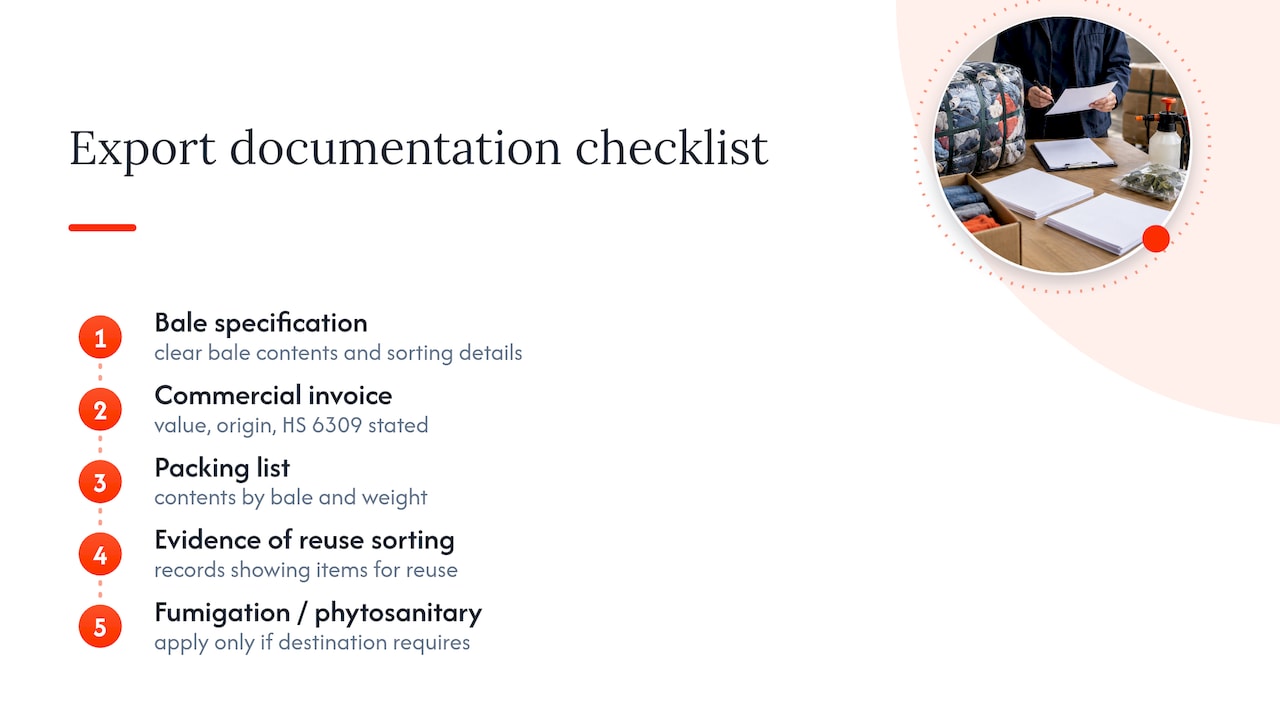
UK guidance on textile exports sets out the core paperwork exporters need: a clear bale specification, a commercial invoice, packing lists and evidence that goods are sorted for reuse rather than disposal. Fumigation or phytosanitary certificates may also apply depending on the destination country’s import rules. Getting this documentation right before the container ships is the single biggest lever for avoiding customs delays.
Building a QA checklist for export-ready bales
A buyer who wants predictable quality should insist on a documented process before placing a large order, not after a shipment arrives short of spec.
- Require sorted, graded bales with contamination (non-textile debris, damaged packaging) fully removed.
- Confirm each bale carries a label showing grade, net weight, contents summary and HS code.
- Ask for a bale specification document and packing list matching the commercial invoice line by line.
- Request photo or video samples of a representative bale before committing to a full container.
- Agree on a dispute process in writing, covering what happens if a bale arrives below the agreed grade.
Pro Tip: Ask for one or two pre-shipment sample bales with full documentation before you commit to a full container. It is the fastest way to test a supplier’s grading consistency.
What drives pricing, MOQs and payment terms
Per-kilogram pricing depends on grade, packing density and how far the stock has to travel. Higher grades and tighter sorting cost more per kilogram, while mixed or lower-grade bales price lower but carry less resale margin.
- Minimum order quantities usually scale with container capacity, so pricing improves as order size approaches a full container load.
- Payment terms commonly split between a deposit at order confirmation and balance before or on dispatch.
- Cargo insurance protects against transit loss or damage and is worth the modest added cost on any container-size shipment.
- Agreeing on an incoterm such as FOB or CIF upfront clarifies who carries risk and cost at each stage of the shipment.
Where to source stock and which markets want which grades
Sourcing hubs vary in what they do best. Large-volume collection centers move high quantities but can mix grades inconsistently, while specialized sorters deliver tighter grading at a higher per-kg cost. Global export data from 2025 shows China shipped roughly 61.2% of global footwear export volume that year, with Vietnam at 11.2% and Indonesia at 4%, a concentration worth weighing when choosing a volume source versus a specialized reseller.
- Markets across Africa and parts of South America often favor Grade B and mixed-grade bales priced for high turnover.
- Southeast Asian resale markets tend to absorb a wider mix, from Grade A for urban retail to lower grades for rural trade.
- Before committing, verify a supplier’s warehouse capacity, ask for references from existing partners and request packing evidence from a recent shipment.
Why a verified warehouse exporter reduces buyer risk
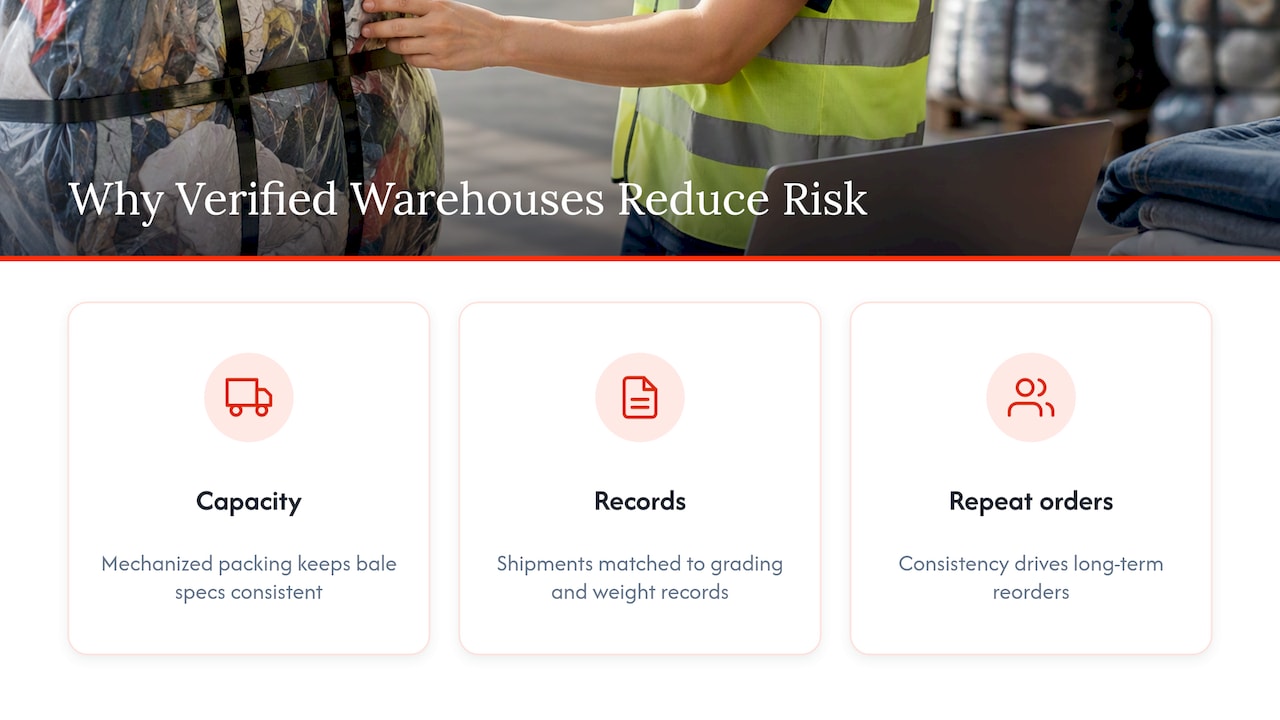
A supplier with real warehouse capacity and mechanized packing equipment cuts the guesswork out of sourcing. A supplier with a large warehouse and advanced packing machinery can keep bale specifications consistent and turnaround fast. Documented shipments, matched to clear grading and weight records, make customs classification smoother and give buyers confidence before the container ever leaves the yard. Long-term partners have pointed to that consistency as the reason they keep reordering.
How to request a quote and start your order
We put together a quote the moment we know what you need, so the more detail you share up front, the faster you get usable numbers back.
- Tell us the grade or grades you want, target bale weights and your destination port.
- Confirm your preferred incoterm (FOB, CIF or another arrangement) and your desired dispatch window.
- Ask for sample photos, a packing specification and the documentation set that applies to your market.
In return, we send sample bale photos, a written packing spec and the logistics options available for your route, along with the paperwork your customs office will expect. Start by visiting our used shoes page to request a quote, and if your order spans categories, our used clothing range covers the same sorting and documentation standards.
An exporter’s honest take on what actually works
Buyers chase the lowest per-kg price and often pay for it later in rejected bales or customs holds. The real negotiation lever isn’t price, it’s documentation: a supplier who hands over a sample bale, a clear spec sheet and photos before you commit is worth a slightly higher rate. Time your pre-shipment inspection before the claims window closes, not after. If a deal feels rushed, ask for a warehouse visit or more samples before you sign.
— rodrigues
FAQ
What is the HS code for second-hand shoes?
Used shoes shipped in bulk generally fall under HS heading 6309, which covers worn clothing and other worn articles rather than new retail footwear. National tariff schedules may apply a more specific subheading, so confirm the exact code with your destination country’s customs authority.
Where can I buy bulk shoes to resell?
Wholesale buyers typically source from warehouse exporters that grade, pack and document bales for international shipment, rather than from retail or consumer marketplaces. We supply graded used footwear bales through our used shoes category, shipped worldwide with packing specifications included. Buyers new to resale can also review general resale business guidance before placing a first order.
Which country is the biggest exporter of shoes?
China remained the largest footwear exporter by volume in 2025, shipping about 61.2% of global pairs, according to global footwear market data.
Is exporting used footwear classified as waste shipment?
It depends on sorting and documentation, not on the fact that the goods are used. UK guidance on textile exports states that sorted, contamination-free consignments with clear specifications and evidence of reuse qualify as non-waste, while unsorted or undocumented loads risk waste classification and added notification controls.
What documents do I need to export used footwear bales?
A standard export package includes a bale specification, a commercial invoice, a packing list and, depending on the destination, fumigation or phytosanitary certificates. These documents demonstrate the goods are sorted for reuse and correctly classified, which customs guidance ties directly to avoiding reclassification or higher duties.
Sources
- HTS search results — 6309.00.00 (USITC)
- Global footwear production and export shares (Shoe Intelligence)
- Gov
- Customs Ruling NY L87070 — tariff classification of used clothing