
A container inspection checklist for used clothing and shoes has four parts: inspect the empty box (front wall, both sides, floor, ceiling, doors, undercarriage), check that it is clean, dry and pest-free, load and seal it in a controlled way, and record everything with photos and the seal number. Do it for every container, before any bale goes in. Below is the full sequence, what each check looks for, when to stop and report, and how to keep records that hold up when a shipment is questioned.
TL;DR
- Use the seven-point empty-container inspection that U.S. Customs and Border Protection recommends: front wall, left side, right side, floor, ceiling or roof, inside and outside doors, and outside with undercarriage.
- Textile bales are vulnerable to moisture and contamination, so treat a wet floor, a musty smell, light leaks or soil and plant matter as reasons to stop.
- Load heavy bales low, fill voids, latch the doors, apply a seal and write down its number.
- Verify the seal at every handoff with VVTT: view, verify, tug, twist.
- Photograph the empty box, the load and the locked seal, and keep the packing list and checklist together.
Table of Contents
- Why used clothing needs its own inspection routine
- What to record before you touch the container
- The seven-point empty-container inspection
- Cleanliness, pests and contamination
- When to reject or report a container
- Loading the container to protect bales
- Sealing practices and seal verification
- Receiving and comparing on arrival
- Records, photos and paperwork to keep
- Mandatory rules and good practice are not the same thing
- Buying bales from a supplier that documents the load
- FAQ
- Sources
Why used clothing needs its own inspection routine
Baled clothing and shoes are dense, absorbent and valuable per cubic meter. A damp floor, a pinhole in the roof or a door gasket that lets in rain can damage an entire load. QIMA’s loading-inspection guidance notes that apparel, footwear and textile shipments may warrant checks for dampness, rust holes, dust, grease and general uncleanliness, plus desiccant bags, dunnage airbags and nets.
There is a second reason. In U.S.-bound trade, the seven-point inspection is also a security control. CBP’s model treats it as a way to prevent unauthorized material or people entering the supply chain, not only a quality check for dents and rust. So a good inspection protects your goods and your clearance at the same time.
This article is general guidance for importers, wholesalers and market traders. Your carrier, forwarder, customs broker and the authorities on your route decide what is mandatory for your shipment.
What to record before you touch the container
The form starts before the doors open. The checklist the research draws on asks for the following header details:
- date and time of inspection
- container number and seal number
- purchase order or bill-of-lading number
- container type
- name of the inspector
Complete one form per container. If you ship several containers to the same buyer, the numbers on each form are what let you prove later which box held which bales.
The seven-point empty-container inspection
Walk the container in this order. It follows the CBP seven-point model, with the detail added by the CTPAT 10-point checklist that one importer publishes for its suppliers.
| Point | What to look for |
|---|---|
| 1. Front wall | Holes, cuts, dents, rust, unusual repairs, color variations that suggest patching |
| 2. Left side | Same as above; tap the panel and listen for hollow sounds |
| 3. Right side | Same as above |
| 4. Floor | Flat, clean, dry, no oil stains, no unexplained changes in height, no sign of a false floor |
| 5. Ceiling and roof | Holes, light coming through, dents, inconsistent repairs, roof bows in place |
| 6. Doors (inside and outside) | Close and open smoothly, gaskets intact, locking mechanism and seal points undamaged |
| 7. Undercarriage and outside | Damaged or corroded members, chassis defects, weld fractures at corner posts, heavily bulged or indented panels |
Chubb’s ocean and intermodal checklist lists the same kinds of exterior defects: holes, punctures, weld fractures at the corner posts, heavily bulged or indented panels, corroded undercarriage members and door damage that affects operation.
Checking the walls and floor
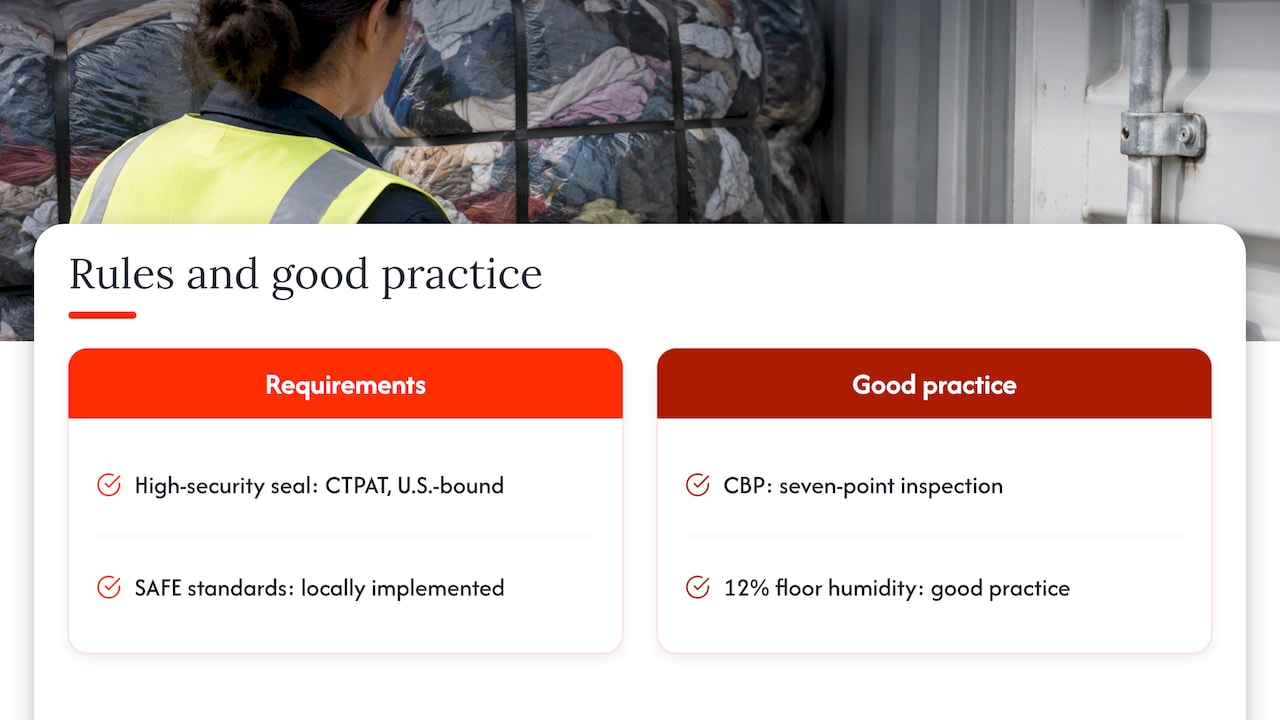
Look for patches that do not match the rest of the panel, and tap the walls. A hollow sound can mean a second wall or hidden space. On the floor, the CTPAT 10-point checklist cites humidity below 12% as the target, so a moisture meter is a worthwhile tool for anyone loading textiles. Unexplained oil stains or a floor that sits at a different height from one end to the other deserve a closer look.
Checking the interior condition
The German Transport Informations Service describes a good interior as absolutely dry, clean, free of cargo residues, neutral in odor and free of nails or other protrusions that could damage cargo. For used clothing, odor matters: a container that smells of chemicals or mildew will transfer that to the bales.
The light test for watertightness
The same source describes a simple test. Step inside, close both doors tightly and look for light coming in through cracks, holes or door gaskets. Any pinpoint of daylight is a path for rain and spray. The CTPAT checklist also describes a controlled rain or wash test for the doors if you want to go further.
Cleanliness, pests and contamination
The CTPAT checklist asks the inspector to check inside and outside for visible contaminants such as plants, seeds, insects, egg masses, snails, animals, animal droppings and soil. The IPPC and IMO container packing checklist asks the same question of both the container and the cargo before packing and dispatch: is it free of soil or visible pest infestation?
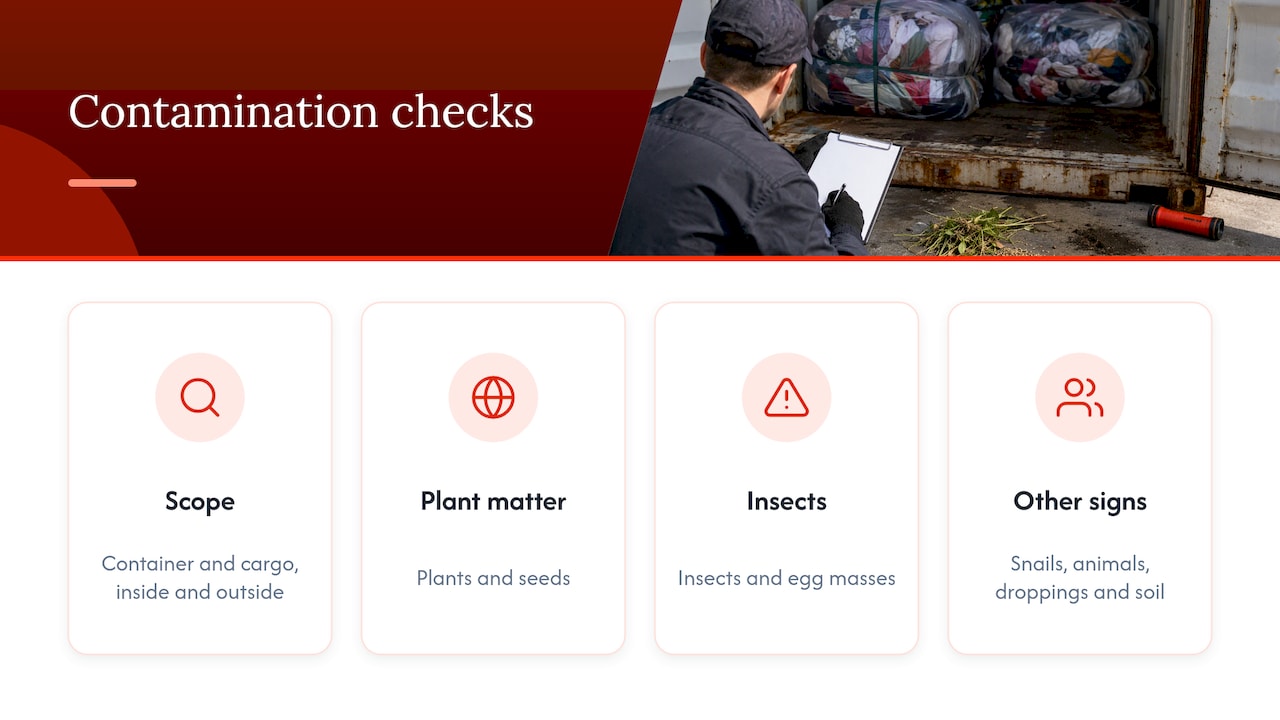
In practice, check the corners, the door tracks and the underside of the roof bows, where seeds and insects collect. Sweep and dry the box before loading if it is dirty, or request another container if cleaning will not fix the problem.
When to reject or report a container
No single source gives a universal reject list for used clothing, so use judgment based on the checks above. These are practical stopping points that follow from the defects the checklists name:
- Structural damage: holes, punctures, weld fractures, heavy bulges, or doors that will not close and lock properly.
- Water risk: light visible through the roof, walls or door gaskets, a wet floor, or rust holes.
- Contamination: soil, plant matter, insects, droppings, strong odors or oil stains.
- Signs of tampering or concealment: hollow-sounding walls, mismatched repairs, an unexplained floor height change, or a damaged seal point.
When you hit one of these, do not load. Record the finding with a photo, note it on the form, tell the carrier or depot that supplied the box, and ask for a replacement. A rejected container with a clear record costs you a delay. A wet load discovered at destination costs you the goods.
If you are importing into the U.S., our guide on avoiding rejections when loading used clothing containers covers the loading side in more detail.
Loading the container to protect bales
Once the box passes, load it as the IPPC and IMO packing checklist describes:
- Put heavier cargo at the bottom and spread it evenly across the floor.
- Keep the center of gravity approximately central.
- Stack in even layers.
- Use locking, blocking or lashing so nothing slides or tips.
- Fill void spaces or control them another way.
- Close and latch the doors.
- Affix a seal and record its number.
For bales, this means placing the heaviest ones (typically shoe bales and dense clothing bales) on the floor and keeping the stack tight to the walls and the door line. QIMA suggests recording the loading method, direction and equipment, the stacking arrangement and layers, any dropped cartons, whether the container is full, the gap-control measures, and the final seal number, including whether the seal is temporary or definitive.
For a full plan, see our container stuffing plan guide and our notes on packing specs and machine strapping.
Our perspective: inspect first, bale second
We ship used clothing, shoes, bags, toys and wiping rags from Poland to buyers in more than 40 countries, so we see what a container problem looks like from the dispatch side. Our view is simple: the inspection is part of the product. A well-graded bale that sits in a leaking container is a bad delivery.
That is why we invest in packaging machinery. Tight, uniform bales load faster, stack more evenly and leave fewer voids to control. Our approach is built around quick turnaround and documented shipments, so the checklist, the photos and the seal number travel with the load and the buyer can compare them on arrival.
Our advice to importers is to ask for the same thing from every supplier: a completed form per container, photos of the empty box, the loaded box and the locked seal, and a packing list inside the doors. We work to give our customers that kind of paper trail and compliance support for global import requirements.
rodrigues
Sealing practices and seal verification
A seal is only useful if it meets the standard and someone checks it. For loaded containers bound for the U.S. under CTPAT, CBP states that a high-security seal meeting or exceeding the current ISO 17712 standard is required, together with written procedures for controlling and applying seals and reporting compromised ones.
ISO 17712 classifies mechanical seals as Indicative (I), Security (S) or High Security (H). According to a CBP bulletin on ISO 17712 seals, CTPAT requires H-class seals with independent laboratory confirmation of physical performance. Other routes and carriers may set their own rules, so confirm with your forwarder.
VVTT at every handoff
The same CBP bulletin gives a four-step check:
- View the seal and the container locking mechanisms.
- Verify that the seal number matches the paperwork.
- Tug the seal to make sure it is firmly attached.
- Twist and turn it to make sure it does not unscrew.
The WCO SAFE Framework frames seals as part of the chain of custody, to be inspected at each change of custody by visual inspection, comparison of the number with the documents, and a record of the check.
If the seal is missing, broken or does not match
The SAFE Framework says a missing, tampered or mismatched seal calls for additional action under the relevant procedure. In practical terms:
- Stop unloading where feasible.
- Photograph the seal, the doors and the paperwork.
- Notify the carrier, the consignee and any customs or security contact your route requires.
- Apply a replacement seal only under authorized instructions.
Allegion’s supply chain security procedure adds that receiving teams should report unexplained seal-number or cargo-layout changes, destroy broken or used seals under supervision, and report unmanifested goods, signs of tampering or secret compartments.
Receiving and comparing on arrival
On arrival, the receiving team does the checks in reverse: seal first, then doors, then load. Compare the shipper’s checklist and photographs with what you physically see. A different stacking pattern or an unexplained gap is a discrepancy worth recording before you unload. For retailers building a dock routine, these receiving procedures for imported inventory are a useful model for how incoming stock is handled.
Do not break the seal until you have photographed it with the number visible and compared that number with the bill of lading.
Records, photos and paperwork to keep
A complete file for each container includes:
- the completed inspection form with the header details above
- photos of the empty container: walls, floor, ceiling, doors
- photos of the loaded cargo and the layout before closing
- a photo of the locked seal with its number legible
- the packing list, with a copy placed in a highly visible spot inside the container, as the Transport Informations Service advises
- notes on any discrepancy and who was told
Allegion’s procedure requires foreign suppliers shipping full containers to send the checklist and digital photographs of the cargo, the container, the palletized layout and the locked seal with a visible number before arrival. Those pre-arrival records give the receiver a baseline. When something differs on arrival, you have evidence rather than an argument.
The research does not set a single retention period, so ask your customs broker how long to keep records for your route. Paperwork also has to match the goods themselves: see our guides on HS code 6309 classification and supplier certificates for U.S. importers.
Mandatory rules and good practice are not the same thing
Some items above are requirements on certain routes, and others are recommended practice. The high-security seal requirement is a CTPAT condition for U.S.-bound loaded containers. The SAFE Framework sets minimum standards that each customs administration implements according to its capacity and legal authority, so what applies in Mombasa, Tema or Lagos can differ from what applies in Newark. The seven-point inspection is a CBP recommendation. Checks like the 12% floor humidity figure come from a supplier checklist and are good practice, not law.
Before you ship, confirm which rules apply with your forwarder and your broker. Our overview of used clothing regulations is a good starting point.
Buying bales from a supplier that documents the load
If you resell used clothing, shoes or accessories, a supplier that inspects and documents each container makes your own receiving easier. We supply used clothing and used shoes in bulk bales from our warehouse in Poland, with advanced packaging machinery designed for fast turnaround and documented shipments.
We also supply used bags, toys, bric-a-brac and industrial wiping rags. To discuss a container, start from our landing page and tell us your destination and the product you need.
FAQ
How many points should a container inspection cover?
Seven is the baseline that CBP recommends: front wall, left side, right side, floor, ceiling or roof, inside and outside doors, and outside with undercarriage. Many checklists extend this to eight, nine or ten points by adding the seal, the locking mechanism and agricultural contamination. Using the longer version costs a few minutes and covers more.
Who should do the inspection?
Whoever loads the container should complete it, and sign and date the form with their name. The receiver then repeats the seal and door checks on arrival. Keeping both records together makes any later discrepancy easier to trace.
What humidity level is acceptable for a container floor?
The CTPAT 10-point checklist cited above uses floor humidity below 12% as its benchmark. That is a supplier checklist figure rather than a legal limit. For baled textiles, a dry floor and no light leaks are the goal, and a moisture meter takes the guesswork out.
What do I do if the seal number does not match the paperwork?
Stop unloading if you can, photograph the seal and documents, and notify the carrier, the consignee and any customs or security contact your route requires. Apply a replacement seal only under authorized instructions, and keep the broken seal for supervised disposal as your procedure directs.
Sources
- CBP Security Profile (CTPAT)
- CBP bulletin on ISO 17712 high security seals
- CTPAT 10-point container inspection checklist
- QIMA, container loading inspections
- IPPC and IMO container packing checklist
- Transport Informations Service, container inspection
- Chubb ocean and intermodal container inspection checklist
- WCO SAFE Framework of Standards
- Allegion supply chain security SOP